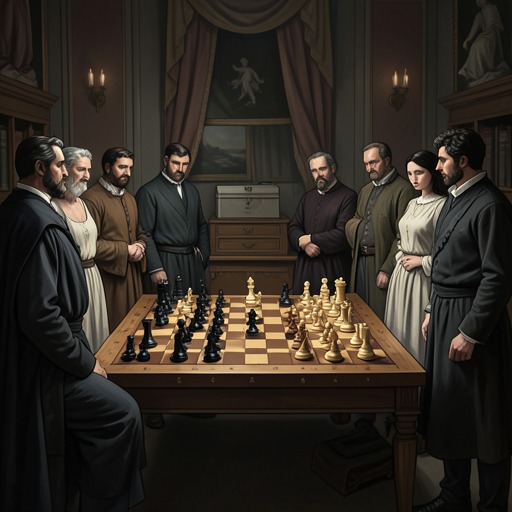
Chess and the Chessboard as Motifs
Los pacientes del doctor GarcíaChess and the Chessboard as Motifs turns a familiar game into a measure of memory, intimacy, and moral belonging. The chess clock and worn set preserved from Guillermo García Medina’s former home carry a past Rafael Cuesta Sánchez has tried to set aside; games with María Aránzazu give his assumed life its first genuine companionship, and a chance encounter with Pepe Moya draws him back toward service. Across these episodes, the board shifts from keepsake to refuge to a figure for the choices by which Rafael recovers a place among others.
The Set as a Material Link to the Past
Among the belongings returned to Rafael in two trunks, the chess set belongs not to the marketable inheritance but to the more personal store of memory. It includes a chess clock, a scratched board, and pieces dulled by use, given to him when he turned fifteen. The set shares space with his childhood stories, medical textbooks, family photographs and letters, and other things from the home at Hermosilla 49. Its worn condition records a history of use rather than financial value: the board is part of the life he had lived as Guillermo García Medina, not merely an object he can sell or replace.
The chess set is one of the few things Rafael keeps close as he begins again under the name Rafael Cuesta Sánchez. When María Aránzazu notices it in his room and asks whether it is a chess clock, the question opens a connection between an object he has retained and a relationship he has not yet formed. The set has survived the displacement of his family possessions and now becomes an occasion for conversation. Its presence makes the old life tangible even as Rafael tries to live apart from the identity it represents.
Games as Company and Cover
Rafael’s response to learning that María Aránzazu can play chess is practical as well as social: by lunchtime, he has bought a bottle of port and a bottle of brandy for her. When she arrives to play, she greets him with delight and goes to fetch a table. From that day, their regular games become a small but consequential part of Rafael’s life. The board offers a reason for the two of them to spend time together without requiring either to name the loneliness or uncertainty surrounding him.
Their afternoons have a distinct, guarded routine. There is a single glass that they share, a packet of cigarettes they smoke between them, and the expectation that they may hear footsteps announcing an intruder in the corridor. Their companionship is thus both ordinary and secretive: they play, drink, and smoke together, but remain alert to the possibility of being interrupted. Chess gives their meetings a socially legible purpose while allowing a friendship to develop under the cover of an apparently harmless pastime.
María is not as strong a player as Manolo, but she can hold her own. Rafael sometimes lets her win, particularly when she has produced an unusually brilliant game; at other times, she earns genuine draws and celebrates them as victories. That balance matters: their connection is not simply his performance for her, since her play can force an honest result. Occasionally she forgoes a rematch, and the game yields to the friendship it has made possible. In the apartment on Españoleto Street, as earlier in the home on Hermosilla Street, chess becomes more than play: it is a pretext for a private, mutually beneficial bond.
A Board That Reopens the Past
The motif acquires a different force when Rafael has moved to an apartment on Apodaca Street. He has furnished it by spending the valuable possessions from one of the trunks, and the feeling of having a home again eases his sense of dislocation. He thinks of the Guillermo García Medina identity as little more than a covering that can be hung away and worn only when no one can see him. Yet just as he tries to separate himself from that past, it catches up with him in a chess club on Bordadores Street.
The encounter begins not with a carefully arranged match but with a disrupted routine. After drawing an earlier game, Rafael is angry at himself for sacrificing a rook and realizing an instant too late that the move was irretrievable. He blames spring, washes his face, and returns to collect his belongings. A spontaneous opponent is waiting, unusual in a club where games are scheduled beforehand. Still irritated with his own play, Rafael accepts the challenge. He hears the newcomer’s youthful voice before seeing him, and the recognition is so overwhelming that he has to sit down: the opponent is Pepe Moya, whom Rafael greets with astonishment.
The board therefore becomes the means by which a concealed past returns in the present. Rafael has not sought out Pepe through a planned reunion; he encounters him across an improvised game, in a setting organized around chess. The scene contrasts with the guarded companionship of his matches with María: there chess sustains a life he is building, while here it unexpectedly reconnects him with people and commitments he had thought lost. The game is not described as the cause of their reunion, but it supplies its immediate form and brings the old relationship into the room.
From a Wrong Board to a Place Among Others
When Pepe later offers Rafael work treating the families of imprisoned people, he frames the request around Rafael’s medical skill and the patients’ need. The work will not be paid, and Pepe cannot promise safety; a raid on a safe house could find Rafael there treating someone. Rafael’s response is emotionally charged. He withdraws to the bathroom, crying, and accepts what he understands as a chance to be useful again.
In recalling the offer, Rafael describes his former position through the language of chess. He had felt as if he had changed sides in order to play with an advantage on a board that did not belong to him. The image gives precise form to his alienation: he has survived, but survival has seemed to place him outside the shared struggle and its risks. The contrast is not between winning and losing. It is between taking shelter from the game others are forced to play and accepting a role in which his abilities can serve them.
The decision restores more than his medical vocation. Rafael understands it as a recovery of dignity and the possibility of being one of the people who act for others, take risks, and remain useful. Remembering Dr. Quintanilla’s argument that his place was in an operating room—or somewhere like one—helps him make sense of why neither imprisonment nor surrender to the police would have served anyone. Pepe’s offer does not erase Rafael’s earlier fear or isolation; it allows him to understand that his skills belong in service rather than withdrawal. Chess, which first preserved a material fragment of his old life and then gave shape to companionship and reunion, finally supplies the image through which he recognizes his estrangement—and the possibility of taking his place again.